All published articles of this journal are available on ScienceDirect.

The Missing Pulse in a Discordant Triad: The Challenge of Biologic Selection in Multisystem Autoimmunity: A Case Report
 iD
Arul RajaMurugan1
iD
Ramesh Subramanian1
iD
Sabarinath Mahadevan1
iD
Ishwarya Ramadoss1
iD
Authors Info & Affiliations
Abstract
Introduction
Takayasu arteritis is a large-vessel vasculitis that clinicians increasingly encounter in the context of other immune-mediated disorders. Even so, finding it in a patient who already has both inflammatory bowel disease and psoriasis is highly unusual. This report outlines the diagnostic workup and targeted biologic management of this rare overlap.
Case Presentation
A 36-year-old woman with a known history of chronic plaque psoriasis and ulcerative colitis was admitted for an elective cesarean section. During routine perioperative checks, she was incidentally found to have an absent left radial pulse. A follow-up Computed Tomography (CT) angiogram revealed complete non-opacification of the left subclavian artery and high-grade concentric stenosis of the left common carotid artery, consistent with Type I Takayasu arteritis. Given her complex autoimmune profile, she was started on intravenous infliximab. She responded well across all affected systems. After four doses, her Indian Takayasu Clinical Activity Score dropped to 1, her colitis symptoms cleared, and her skin plaques healed. She continues to remain stable in outpatient follow-up.
Conclusion
This case highlights the challenges of biologic selection in patients with coexisting immune-mediated diseases affecting multiple organ systems. The favorable response to infliximab in our patient suggests that a single biologic agent may achieve effective control of vascular, intestinal, and cutaneous disease manifestations in complex autoimmune overlap syndromes.
1. INTRODUCTION
Takayasu arteritis is a progressive inflammatory disease of the vessel wall that can lead to stenosis, occlusion, or aneurysm formation. Diagnosis is often delayed because early symptoms are nonspecific. Computed Tomography (CT) and Magnetic Resonance (MR) angiography help assess vascular involvement and structural damage; imaging findings should be interpreted alongside clinical and laboratory assessments of disease activity [1, 2]. Tumor necrosis factor inhibitors are an option for active Takayasu arteritis that is refractory to conventional immunosuppressive therapy, although the supporting evidence is limited [2].
Takayasu arteritis may coexist with other immune-mediated inflammatory diseases. Shared genetic susceptibility and inflammatory pathways have been proposed to link vascular, intestinal, and cutaneous disease, but these associations do not establish the mechanism in an individual patient [3]. This overlap complicates treatment selection when a single agent is needed to address multiple conditions.
We report a case of triple autoimmune overlap involving Takayasu arteritis, ulcerative colitis, and chronic plaque psoriasis. The case highlights the complexity of multisystem disease and the challenge of selecting a biologic agent capable of achieving effective control across all affected systems.
2. CASE PRESENTATION
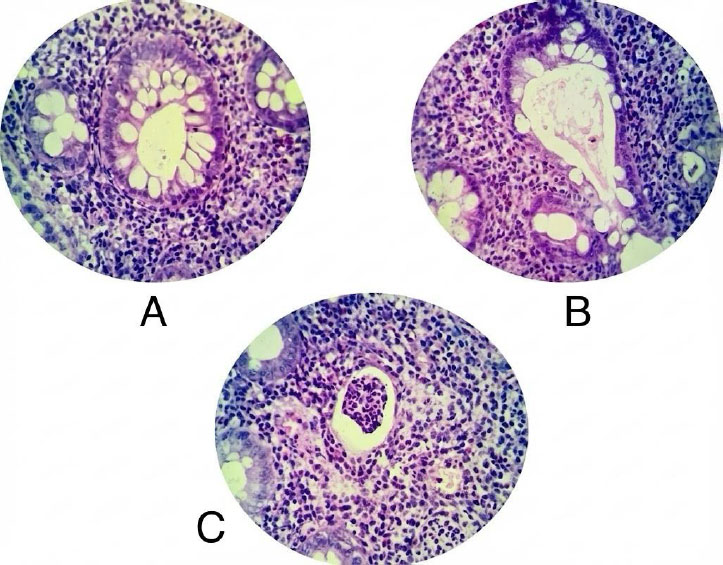
A 36-year-old woman was referred to our center after her second cesarean section when an absent left radial pulse and unrecordable blood pressure in the left arm, noted during routine pre-anesthetic assessment, prompted further evaluation. Her medical history was notable for long-standing plaque psoriasis (Fig. 1), first diagnosed at the age of 16, which achieved prolonged remission with topical corticosteroid therapy by the age of 25. In addition, at 31 years of age, she developed severe abdominal pain, tenesmus, weight loss, and frequent episodes of bloody stools. Colonoscopy with biopsy revealed chronic active colitis with crypt abscesses, cryptitis, mucosal ulceration, and goblet cell depletion, confirming a diagnosis of ulcerative colitis (Fig. 2). She received treatment with oral mesalamine and systemic corticosteroids for one year and achieved remission, following which she discontinued treatment on her own. Upon directed questioning, she reported mild exertional pain in the left arm, consistent with upper-limb claudication, but denied visual symptoms, chest pain, syncope, or neurological complaints.
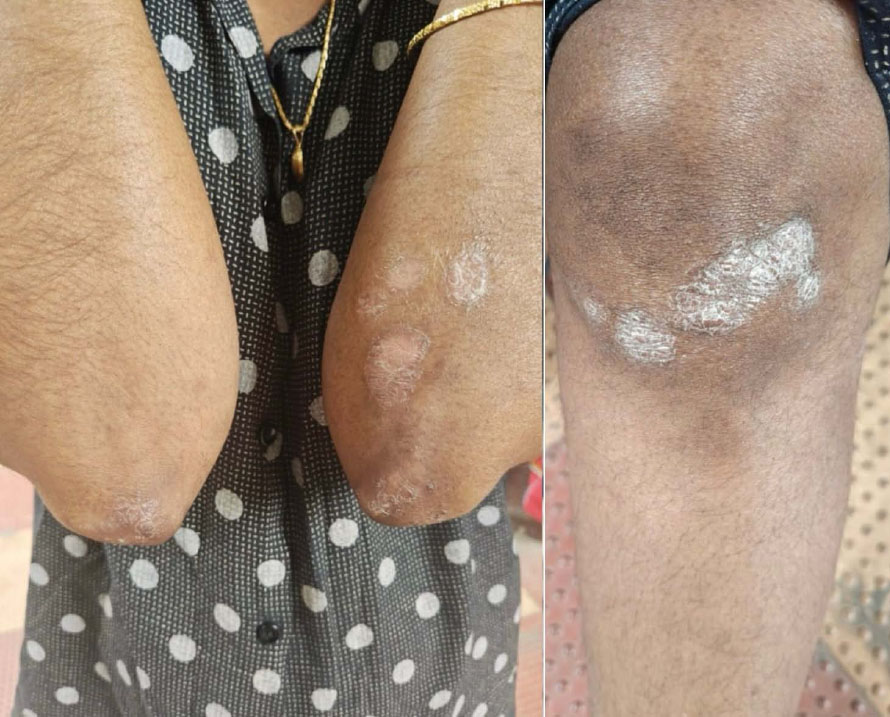
Physical examination confirmed she was afebrile and hemodynamically stable. Blood pressure in her right arm was normal at 118/72 mm Hg. On the left side, however, the brachial pulse was barely palpable, the radial pulse was absent, and blood pressure could not be measured. Auscultation revealed a distinct bruit over the left carotid artery. The remainder of her cardiovascular and neurological examinations was unremarkable. A dermatological examination showed classic erythematous, scaly plaques on her left elbow, knee, and lower leg. Initial laboratory investigations demonstrated marked systemic inflammation, with a C-Reactive Protein (CRP) level exceeding 200 mg/L (laboratory reference range: <6 mg/L). The initial Erythrocyte Sedimentation Rate (ESR) was 90 mm/h. Following the immediate initiation of oral steroid therapy, repeat testing showed a decrease in CRP to 6 mg/L and ESR to 38 mm/h. Her liver and renal function tests and complete blood counts were within normal limits. Antinuclear antibody, antineutrophil cytoplasmic antibody, HLA-B27, and HLA-B51 testing were negative. HLA-B27 and HLA-B51 were assessed in relation to spondyloarthritis-spectrum and Behcet disease-related differential considerations, respectively. HLA-B*52:01 and IL12B genotyping were not performed.
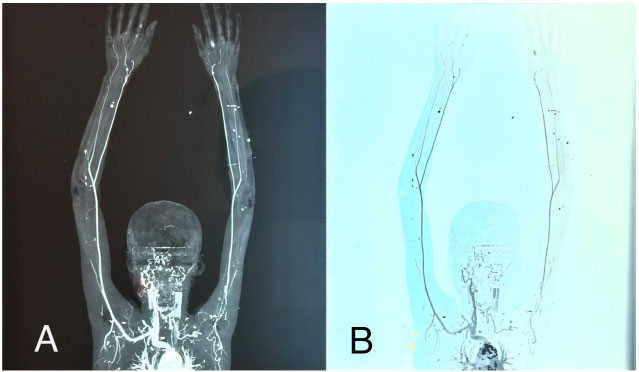
To investigate the vascular deficit, a computed tomography angiogram was performed. The imaging revealed concentric wall thickening and high-grade stenosis of the left common carotid artery, along with complete non-opacification of the left subclavian artery from its origin. These structural changes were consistent with Type I Takayasu arteritis (Fig. 3) [4]. A subsequent magnetic resonance angiogram of the brain ruled out acute stroke but demonstrated reduced blood flow in the left carotid territory and a hypoplastic left vertebral artery. Based on these findings, she met the 2022 ACR/EULAR classification criteria for Takayasu arteritis [5]. Clinically, active vasculitis manifested as pulse loss, marked inter-arm blood pressure discrepancy with an unrecordable pressure in the left arm, a left carotid bruit, and upper-limb claudication. The recorded initial Indian Takayasu Clinical Activity Score (ITAS2010) was 4 [6]. She was maintained on a tapering dose of oral prednisolone, with aspirin and atorvastatin added for cardiovascular protection. Given the convergence of Takayasu arteritis, ulcerative colitis, and psoriasis, the clinical team required a single biologic strategy capable of addressing all three immune-mediated conditions simultaneously. Her ulcerative colitis symptoms had recurred, with bloody diarrhea present at the time of infliximab initiation. Infliximab was initiated at 200 mg intravenously every 2 months; four doses were administered. Following the fourth dose, her multisystem inflammation was effectively controlled. Her ITAS2010 decreased to 1 [6], her colitis symptoms resolved, and her psoriatic skin lesions healed. The patient remains stable and continues to be monitored closely in the outpatient clinic. The clinical course, investigations, and treatment are summarized in Table 1.
| Age / Time Point | System Involved | Key Features | Investigations | Management |
|---|---|---|---|---|
| 16 years | Skin | Plaque psoriasis | Clinical diagnosis | Topical therapy |
| 31 years | Gastrointestinal | Bloody diarrhea; weight loss | Colonoscopy and biopsy | Mesalamine; corticosteroids |
| 32-36 years | Gastrointestinal | Asymptomatic | Not applicable | Treatment discontinued |
| 36 years (postpartum) | Vascular | Absent radial pulse; carotid bruit; claudication | CTA; MRA | Corticosteroids; aspirin; atorvastatin |
| At infliximab initiation | Multisystem | Active TAK, UC with bloody diarrhea, and psoriasis | Imaging and laboratory tests | Infliximab 200 mg IV every 2 months |
| After four doses | Multisystem | Colitis symptoms resolved; plaques healed | ITAS2010 decreased to 1 | Outpatient follow-up |
Before infliximab treatment, tuberculosis screening was negative on both Mantoux testing and an interferon-gamma release assay. HIV testing was negative, and there was no history of recurrent infections; serum immunoglobulin levels were not measured.
3. DISCUSSION
Ulcerative colitis is a recognized coexisting condition in Takayasu arteritis. A cohort study reported a high rate of co-occurrence and shared genetic susceptibility involving HLA-B*52:01 [7]. In many reported cases, inflammatory bowel disease preceded the recognition of vasculitis. Compared with Takayasu arteritis alone, coexisting inflammatory bowel disease was associated with more frequent constitutional and gastrointestinal symptoms [8]. A multi-ancestral genome-wide association study reinforced IL12B as a susceptibility locus, with epigenetic analyses suggesting roles for monocytes and B cells [9]. These population-level findings do not establish a genetic mechanism in this patient, in whom HLA-B*52:01 and IL12B were not tested.
Psoriasis and inflammatory bowel disease are known to coexist [10, 11]. Shared inflammatory pathways, including IL-23/Th17 signaling, may help explain this association [10]. Although IL-17 inhibition can improve psoriasis, trials in Crohn’s disease showed no benefit and, in some cases, disease exacerbation [10]. Infliximab has established efficacy in ulcerative colitis and psoriasis and therefore provides a rationale for selecting a treatment that can address both conditions [10]. The proposed convergence of these pathways with the immunobiology of Takayasu arteritis remains a plausible explanation for the triad rather than a demonstrated mechanism [3, 7, 9, 10].
The reported association supports considering large-vessel vasculitis in patients with inflammatory bowel disease who develop constitutional symptoms, limb claudication, or reduced peripheral pulses [8].
Treatment selection must also account for vascular inflammation. The Chinese guideline for Takayasu arteritis recommends considering biologic therapy, including tumor necrosis factor inhibitors, for relapsing or refractory disease after failure of conventional immunosuppressive therapy [2]. A single-center observational cohort of 41 patients reported prolonged infliximab use in Takayasu arteritis, with dose escalation required in 28 patients [12]. Together with the efficacy of infliximab in ulcerative colitis and psoriasis [10], this evidence supports the rationale for its use in the present case. It does not establish comparative superiority or prove efficacy for all patients with this specific overlap.
Screening for latent tuberculosis is recommended before starting tumor necrosis factor inhibitors [13]. This recommendation is particularly relevant in settings with a high tuberculosis burden. In this patient, both Mantoux testing and the interferon-gamma release assay were negative before infliximab was initiated.
Coexistence of Takayasu arteritis, psoriasis, and ulcerative colitis has previously been reported. Łoń et al. described Type IV Takayasu arteritis developing during etanercept therapy for childhood-onset psoriasis, with ulcerative colitis diagnosed subsequently. The authors discussed possible etanercept-associated Takayasu arteritis, but drug causation was not established [14]. In our patient, ulcerative colitis and chronic plaque psoriasis preceded recognition of Type I Takayasu arteritis, which was identified before infliximab initiation. Infliximab was selected to address the established multisystem disease, with clinical improvement observed during concomitant glucocorticoid treatment. Thus, this case differs in disease sequence, vascular distribution, and treatment context; it does not represent the first report of the overlap or establish comparative efficacy between biologics.
4. LIMITATIONS
This report is limited by its single-patient design, the relatively short observation period after four infliximab doses, concomitant glucocorticoid treatment, and the inability to infer causality from clinical response. Patient-specific genetic inference is limited because HLA-B*52:01 and IL12B testing were not performed. These limitations restrict the generalization of the therapeutic outcome.
CONCLUSION
This case demonstrates the challenges of therapeutic decision-making in patients with coexisting immune-mediated diseases involving multiple organ systems. Rather than addressing each manifestation in isolation, treatment selection should be guided by the overall disease phenotype and the need to achieve control across all affected systems. The favorable response observed in our patient suggests that a single biologic agent may be an effective treatment strategy in carefully selected cases of complex autoimmune overlap.
AUTHORS’ CONTRIBUTIONS
The authors confirm their contribution to the paper as follows: Original Draft Preparation: AP. Reviewing and Editing: AR, RS, SM, and IR. All authors reviewed and approved the final version of the manuscript.
LIST OF ABBREVIATIONS
| ACR | = American College of Rheumatology |
| ANCA | = Antineutrophil Cytoplasmic Antibody |
| CRP | = C-Reactive Protein |
| CT | = Computed Tomography |
| CTA | = Computed Tomography Angiography |
| ESR | = Erythrocyte Sedimentation Rate |
| EULAR | = European Alliance of Associations for Rheumatology |
| HIV | = Human Immunodeficiency Virus |
| HLA | = Human Leukocyte Antigen |
| IBD | = Inflammatory Bowel Disease |
| IL | = Interleukin |
| ITAS2010 | = Indian Takayasu Clinical Activity Score 2010 |
| IV | = Intravenous |
| MIP | = Maximum Intensity Projection |
| MR | = Magnetic Resonance |
| MRA | = Magnetic Resonance Angiography |
| TAK | = Takayasu Arteritis |
| TNF | = Tumor Necrosis Factor |
| UC | = Ulcerative Colitis |
ETHICS APPROVAL AND CONSENT TO PARTICIPATE
As this is a retrospective single-case report, formal ethical approval was waived by the institutional ethics committee (institutional details withheld for double-blind review). Written informed consent was obtained from the patient for publication of the case and accompanying clinical details and images.
HUMAN AND ANIMAL RIGHTS
No animals were used in this research. All human research procedures followed were in accordance with the ethical standards of the committee responsible for human experimentation (institutional and national), and with the Helsinki Declaration of 1975, as revised in 2013.
CONSENT FOR PUBLICATION
Written informed consent was obtained from the patient for publication of this case report and accompanying clinical details and images.
ACKNOWLEDGEMENTS
Declared none.